Concrete Floor Repair + Coating Boston, MA
Crack repair, spall filling, and surface restoration before coating — restoring degraded Boston-area slabs in one mobilization. Free written estimate.
Call Now: (857) 340-4574Boston Concrete Repair Before Every Coating Job
Boston Epoxy Floor Pros does not coat over damage. Every installation includes a thorough slab assessment, and every crack, divot, spall, and joint failure is addressed before the epoxy system goes down — in one mobilization, not as a separate call. This is standard practice on every job, not an upsell: attempting to coat over unrepaired concrete produces high spots, voids, and coating failures that void the warranty and require complete removal and reinstallation. The repair work is documented in your written estimate so you know exactly what's being done and why. Call (857) 340-4574 for a free on-site assessment.
Why Boston Slabs Need More Repair Work Than Most
Greater Boston's concrete stock has been subject to two of the most damaging forces a slab can face: freeze-thaw cycling and chloride intrusion. The region averages 50+ freeze-thaw cycles per year — every cycle expands water in the concrete matrix by roughly 9%, generating internal pressure that produces surface pop-outs, scaling, and progressive delamination of the top layer. Over 20-30 years, this produces the pitting and surface roughness you see on most pre-2000 Boston-area garage and basement slabs.
Road salt compounds the damage. Chloride ions from calcium chloride and sodium chloride deicers penetrate concrete capillaries and accelerate carbonation — the process by which concrete loses its alkalinity and begins to weaken from within. The result, on slabs with significant salt exposure history, is friable surface layers that need to be removed by diamond grinding before any coating will bond durably.
We handle both: the diamond grind removes the contaminated surface layer, and the repair phase addresses the structural damage beneath. For slabs with extensive spalling, this may require cement slurry infill over the entire surface before the epoxy system is applied. The written estimate specifies what level of repair your slab requires.
Project Details
| Repair Type | Method | Outcome |
|---|---|---|
| Hairline cracks | Semi-rigid polyurea injection or rout-and-fill | Sealed, blended into finished floor |
| Structural cracks (1/4"+ wide) | Routing, polyurea fill with bond breaker at joint | Crack sealed; joint preserved as moving joint if structural |
| Control joint cracks | Semi-rigid polyurea fill — maintains joint flexibility | Sealed but flexible through freeze-thaw cycles |
| Surface spalling / pop-outs | Portland cement slurry fill, feathered to surface plane | Flat surface restored for uniform coating adhesion |
| Widespread surface scaling | Diamond grind to remove friable layer + cement slurry skim | Sound bondable substrate exposed |
| Oil contamination | Degreasing treatment + additional diamond grind pass | Contamination removed from bonding zone |
| Final pricing | Quoted per job after on-site inspection — every quote itemized in writing | |
Our Process
On-Site Slab Assessment
We document every defect: crack locations and widths, spalling extent, staining sources, existing coating condition, and moisture vapor readings. The assessment is the basis for the itemized written estimate — we photograph and measure every repair area so there are no surprises on install day.
Diamond Grinding
Full-surface diamond grind to CSP 2-3. On slabs with significant surface contamination or scaling, this step alone removes the compromised layer and exposes the sound concrete beneath. Most oil contamination, paint residue, and failed coatings are fully removed in this step.
Crack Routing and Polyurea Fill
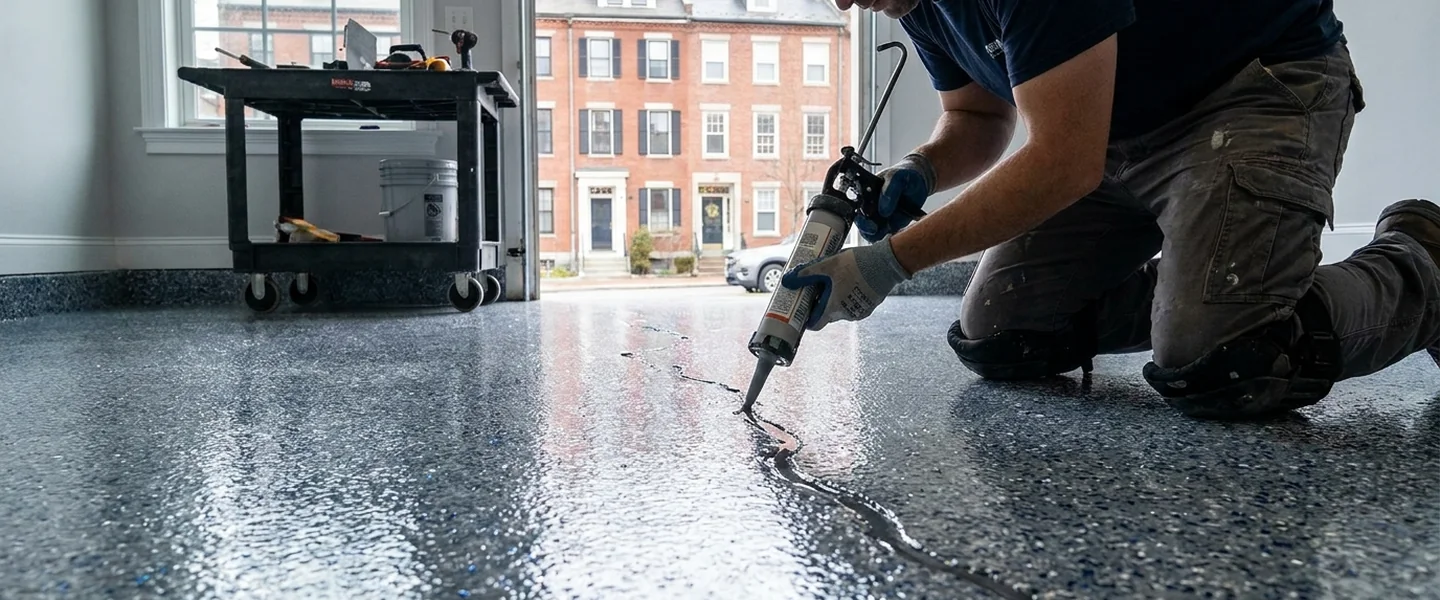
Cracks wider than 1/16" are routed with a crack chaser saw before filling — routing opens the crack to a uniform V-groove profile that the polyurea fills completely, with no voids. Semi-rigid polyurea is specified for slabs subject to freeze-thaw movement: it flexes with the concrete rather than re-cracking at the repair line.
Spall and Divot Repair
Surface pop-outs and spalled areas are filled with Portland cement slurry mixed to a paintable consistency and feathered to the surrounding slab plane. For extensive spalling across the whole surface, we apply a skim coat over the entire slab after grinding to create a uniform plane for coating.
Epoxy System Application
Once repairs are fully cured, the epoxy system goes down — base coat, flake broadcast, and polyaspartic topcoat per the homeowner's selection. The repair areas are indistinguishable from the surrounding slab in the finished floor.
Final Walkthrough
We walk the finished floor, point out the repaired areas so you know where they are, and confirm the repairs are fully blended into the finished surface. Written warranty covers the repaired areas on the same terms as the rest of the floor.
Common Repair Scenarios in Greater Boston
Salt-Spalled 1970s Garage Slabs
The most common repair scenario in Quincy, Medford, Dedham, and South Shore communities: 40+ years of road salt exposure has produced pitting and scaling across the slab surface. Diamond grinding removes the top 1/16" to 1/8" of compromised concrete, and a skim coat levels the surface for coating.
Control Joint Cracking
Control joints in Boston-area slabs that have seen freeze-thaw cycles for decades often show cracking at the joint edge. We fill with semi-rigid polyurea to keep the joint sealed while preserving its flexibility — coating over a rigid fill in a moving joint produces a crack in the topcoat within one or two winters.
Failed Previous Coatings
Big-box epoxy paint and DIY coating kits that have failed — typically because the original installer skipped diamond grinding. We grind off the failed coating, assess the substrate beneath, repair any damage, and install the correct system. This is one mobilization, not two.
Construction Damage in Renovated Homes
Garage slabs in recently renovated Newton and Brookline homes often show staging damage from the renovation — drywall compound drops, paint spills, impact divots from equipment. We address all construction residue in the prep stage before the epoxy system is applied.
Warranty in Detail
Repaired areas are covered under the same 15-year warranty as the rest of the floor — delamination, UV chalking, and hot-tire lift. The warranty specifically includes failure of the repair fill if it re-cracks or voids under the coating within the warranty period. What it does not cover: new cracking caused by structural movement post-install (a slab that continues to settle after repair), damage from impact, or chemical spills not cleaned within 72 hours.
We document every repair location with photos taken before and after — these are in your project file and available on request for insurance purposes or future contractors working on the slab.
Frequently Asked Questions
Can you coat a severely damaged floor?
Usually yes — but the threshold matters. Slabs with extensive structural cracking (wide, moving cracks indicating foundation settlement), complete surface delamination, or active water intrusion may require a structural fix before coating. We identify these at the on-site inspection and will tell you honestly if a coating isn't the right first step.
Will crack repairs be visible in the finished floor?
In most cases, no. The polyurea fill blends into the surrounding slab at the grind level, and the flake broadcast covers both the original slab and the repair uniformly. Very wide cracks (1/2"+) may have a faint linear shadow in raking light, but this is rare and typically not visible in normal lighting conditions.
How long do concrete repairs take to cure before coating?
Semi-rigid polyurea fill reaches handling strength in 30-60 minutes. Portland cement slurry repairs require 24 hours of cure before the epoxy system can go over them. We schedule the repair phase to accommodate cure windows within the overall install timeline — typically, repairs happen on day one and coating begins on day two.
Do you repair cracks that go through the full slab depth?
We fill and seal full-depth cracks, but full-depth cracking (T-cracks, diagonal corner cracks, cracks with vertical displacement) should also be evaluated by a structural engineer if the cause is unknown. We coat and seal — we don't provide structural engineering assessments. For cracks with visible displacement, we'll note this in the inspection and recommend an engineer review before coating.
Do you handle oil stains before coating?
Yes. Heavy oil contamination is treated with a degreasing solution and an additional diamond-grind pass to remove the contaminated surface layer. Persistent oil that has penetrated more than 1/4" deep may require a specialty oil-tolerant primer — this is identified at inspection and specified in the quote.
Free Concrete Repair Assessment — Greater Boston
We document every defect. Written itemized quote within 24 hours. One mobilization from repair through finished coating.
Call (857) 340-4574What You Get in Our Quote vs. the Lowball Bid
We don't compete on the lowest sticker price — we compete on the quote that gets the job actually done. Here is what is included in every quote we write, and the cut-corners that show up in cheaper bids.
Included in our written quote
- Concrete moisture + porosity testing
- Crack and pitting repair before coating
- Full diamond-grind surface prep
- Written quote with flake/coat specs
- Cure-time schedule you can plan around
- 5-year warranty against delamination
Cut corners in the lowball bid
- Coating over uncured or wet slab
- Roller-only prep (no diamond grind)
- Lowball quotes without crack repair
- Subbed-out installation
- No moisture testing before coat
- Warranties full of fine print