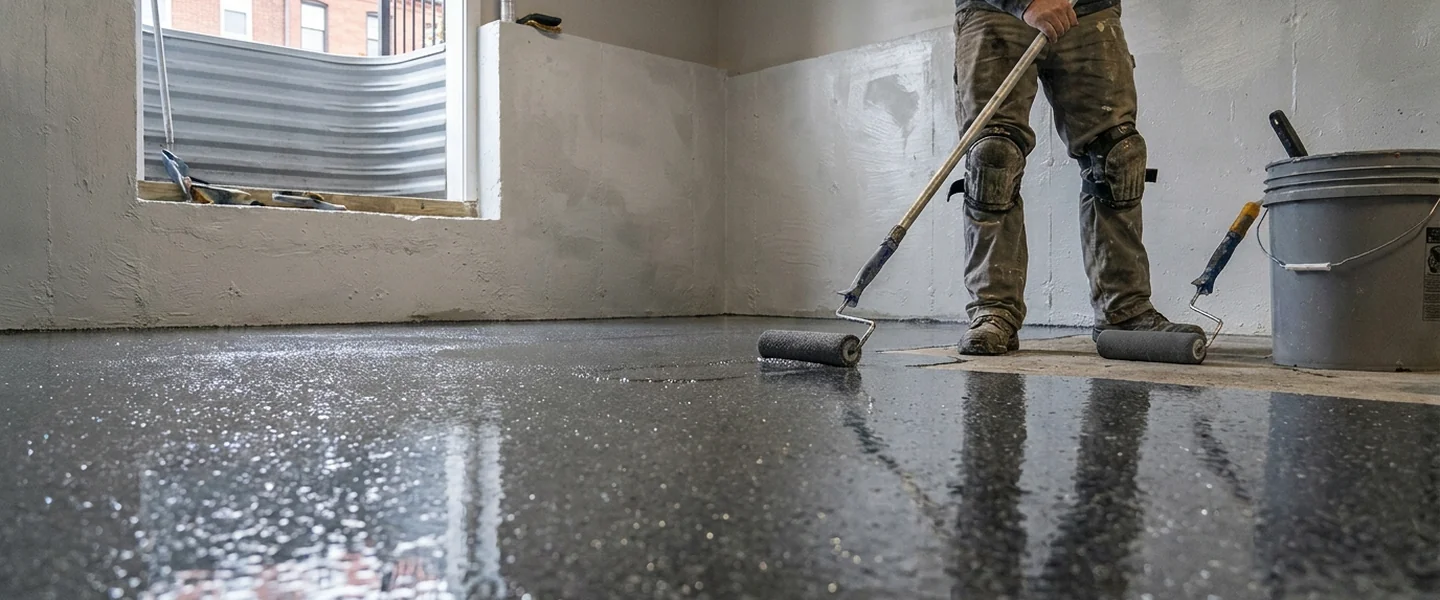
Basement Floor Epoxy Coating Boston, MA
Moisture-tolerant basement floor epoxy with vapor-block primer for Greater Boston's high-water-table properties. Transforms unfinished slabs into durable, finished surfaces. Free written estimate.
Call Now: (857) 340-4574Basement Epoxy That's Built for Boston's Ground Conditions
Boston-area basements present a specific challenge that most residential epoxy installers underestimate: moisture vapor emission (MVE). Greater Boston sits on glacial till, clay, and coastal sediment deposits that hold groundwater close to the surface across much of the metro — Cambridge, Somerville, Charlestown, and much of South Boston have historically high water tables. When moisture vapor migrates through a concrete slab and encounters an impermeable coating applied without a vapor-tolerant primer, the result is osmotic blistering — the coating delaminates from the inside out, often within the first year. Boston Epoxy Floor Pros tests for MVE on every basement job and specifies the appropriate primer before any coating goes down. Call (857) 340-4574 for a free on-site estimate.
What Makes Boston Basements Different
The Boston metro area's geology creates moisture vapor conditions that are more challenging than most Sun Belt or arid-climate cities where residential epoxy is commonly installed. The region sits atop glacial deposits that retain moisture year-round, and many basement slabs were poured without vapor barriers — a standard omission in pre-1980 construction across Massachusetts, Connecticut, and Rhode Island.
Seasonal variation compounds the problem. Spring snowmelt raises groundwater levels and drives moisture vapor through slabs at rates that can exceed 10 lbs per 1,000 sq ft per 24 hours — three times the threshold where standard epoxy systems blister. Our vapor-block primer system handles MVE up to 25 lbs and is the mandatory specification for any basement job where testing shows elevated readings. We document the test results and include the primer specification in your written quote so there are no surprises.
Project Details
| Detail | Specifics |
|---|---|
| Install Timeline | 2-3 days (primer, base coat, topcoat with required cure windows) |
| MVE Testing | Calcium chloride test performed on every basement job before system specification |
| Prep Method | Commercial diamond grinding, crack and divot repair, edge detailing |
| Primer | Vapor-block epoxy primer where MVE exceeds 3 lbs/1,000 sq ft/24 hrs |
| System Layers | Vapor-block primer (if needed), moisture-tolerant epoxy base, vinyl flake broadcast, polyaspartic topcoat |
| Flake Options | 20+ color blends — lighter palettes popular for basement spaces to maximize light reflection |
| Warranty | 15 years against delamination, UV chalking, and hot-tire lift |
| Pricing | Quoted per job after free on-site inspection and MVE test — itemized in writing |
Our Installation Process
On-Site Inspection and MVE Test
We inspect the slab, look for efflorescence (white salt deposits — a visible indicator of moisture migration), existing cracks and damage, and run a calcium chloride test. Results are available within 24-72 hours and determine whether a standard moisture-tolerant primer or an elevated vapor-block primer is required. The test cost is included in the service.
Diamond Grinding
Full slab diamond grinding to CSP 2-3 — including corners and wall edges with a hand grinder. Basement slabs often have surface contamination from years of storage, paint spills, and ground-level moisture. The grind removes this layer completely.
Crack and Efflorescence Treatment
Hairline cracks and control joint cracks are routed and filled with semi-rigid polyurea. Active efflorescence is treated with a crystalline sealer that migrates into the concrete and blocks the salt migration pathway before the coating goes down. Untreated efflorescence under a coating will push the coating off the slab.
Vapor-Block Primer Application
Where MVE testing indicates elevated moisture, the vapor-block primer is applied first at the manufacturer's specified spread rate and allowed to fully cure before the epoxy base coat. This layer is the key to long-term adhesion in high-MVE Boston basements.
Base Coat, Flake Broadcast, and Topcoat
Moisture-tolerant epoxy base coat, full vinyl flake broadcast to rejection, and UV-stable polyaspartic topcoat — same system as the garage coating, with the additional primer layer where required by MVE readings.
Final Walkthrough and Documentation
MVE test results, primer specification, product data sheets, and written 15-year warranty all provided at project completion. The documentation file is valuable if you finish the basement in the future — the contractor will know exactly what's under the floor.
Common Boston Basement Scenarios
Pre-1980 Slabs Without Vapor Barriers
The majority of Boston-area homes built before 1980 have basement slabs poured directly on fill without a poly vapor barrier. These slabs are common candidates for elevated MVE. We test before specifying — the answer is never assumed from the age of the home alone.
Triple-Decker Basement Conversions
Somerville, Jamaica Plain, and South Boston triple-deckers with basement units being finished for rental or owner use. The coating is the first step in the finishing sequence — moisture management has to be solved at the slab level before framing and insulation go in.
Previously Painted Slabs
Old basement floor paint that's chipping and peeling is removed by diamond grinding. If paint has been down for decades and shows no adhesion failures, the grind may remove it partially — we evaluate and specify the approach in the estimate.
Gym and Recreation Spaces
Newton, Brookline, and Cambridge homeowners converting basements to home gym or recreation spaces. The anti-slip broadcast flake finish handles rubber mat placement, weight equipment, and the impact of a basement workout without degrading.
Warranty in Detail
15-year warranty against delamination, UV chalking, and damage from moisture vapor emission — provided that the MVE test results at time of install are documented and the specified primer system was applied. The warranty specifically covers moisture-driven delamination when the correct primer has been applied per spec. This is a meaningful distinction: contractors who skip MVE testing and apply standard epoxy to a high-MVE slab are not providing a moisture warranty — they're applying a product that isn't rated for the conditions and hoping it holds.
What the warranty does not cover: active water intrusion from foundation cracks, wall leaks, or floor drains backing up (structural water entry, not vapor); damage from chemical spills left unaddressed over 72 hours; impact damage; or modification of the coating by a third party.
Frequently Asked Questions
How do I know if my basement has a moisture problem?
Visible indicators include efflorescence (white chalky deposits on the slab surface), damp spots, musty smell after rain, and peeling of any previous floor paint or coating. The only definitive measurement is a calcium chloride test, which we perform on every basement job before specifying the system.
Can you coat a basement that has had standing water?
In most cases, yes — but active water intrusion from foundation cracks or wall seepage needs to be addressed before coating. A coating applied over an active leak will fail. We identify intrusion sources at the inspection and can recommend waterproofing contractors if the source requires a separate fix. Once intrusion is resolved, the slab is a coating candidate.
How long after coating can I lay flooring over it?
Most flooring contractors recommend waiting 30 days after an epoxy coating before laying vinyl plank, laminate, or engineered hardwood over it. The coating is fully cured within 72 hours, but the 30-day window allows any residual off-gassing to complete and gives the installer confidence the surface is fully stable.
Can a basement floor be coated in winter?
Basement temperatures in Massachusetts typically stay above 50°F year-round due to ground insulation, making them easier to schedule in winter than garages. We verify slab temperature before starting — if the basement is unheated and temps have dropped below threshold, we use space heaters to bring the slab up to operating range before install.
What's the best flake color for a basement?
Lighter palettes — dove grey, sand, cream-based blends — reflect more light and make basement spaces feel larger. Darker palettes work well in basements with good lighting, but in below-grade spaces with limited natural light, lighter flake blends are the standard recommendation. We bring physical samples to the on-site visit.
Do you serve all Greater Boston neighborhoods?
We serve Greater Boston and surrounding communities including Cambridge, Somerville, Quincy, Newton, Brookline, Dedham, Waltham, and Medford. Call (857) 340-4574 to confirm your address.
Free Basement Floor Estimate — Greater Boston
MVE testing included. Written quote within 24 hours. Same-week appointments available.
Call (857) 340-4574What You Get in Our Quote vs. the Lowball Bid
We don't compete on the lowest sticker price — we compete on the quote that gets the job actually done. Here is what is included in every quote we write, and the cut-corners that show up in cheaper bids.
Included in our written quote
- Concrete moisture + porosity testing
- Crack and pitting repair before coating
- Full diamond-grind surface prep
- Written quote with flake/coat specs
- Cure-time schedule you can plan around
- 5-year warranty against delamination
Cut corners in the lowball bid
- Coating over uncured or wet slab
- Roller-only prep (no diamond grind)
- Lowball quotes without crack repair
- Subbed-out installation
- No moisture testing before coat
- Warranties full of fine print