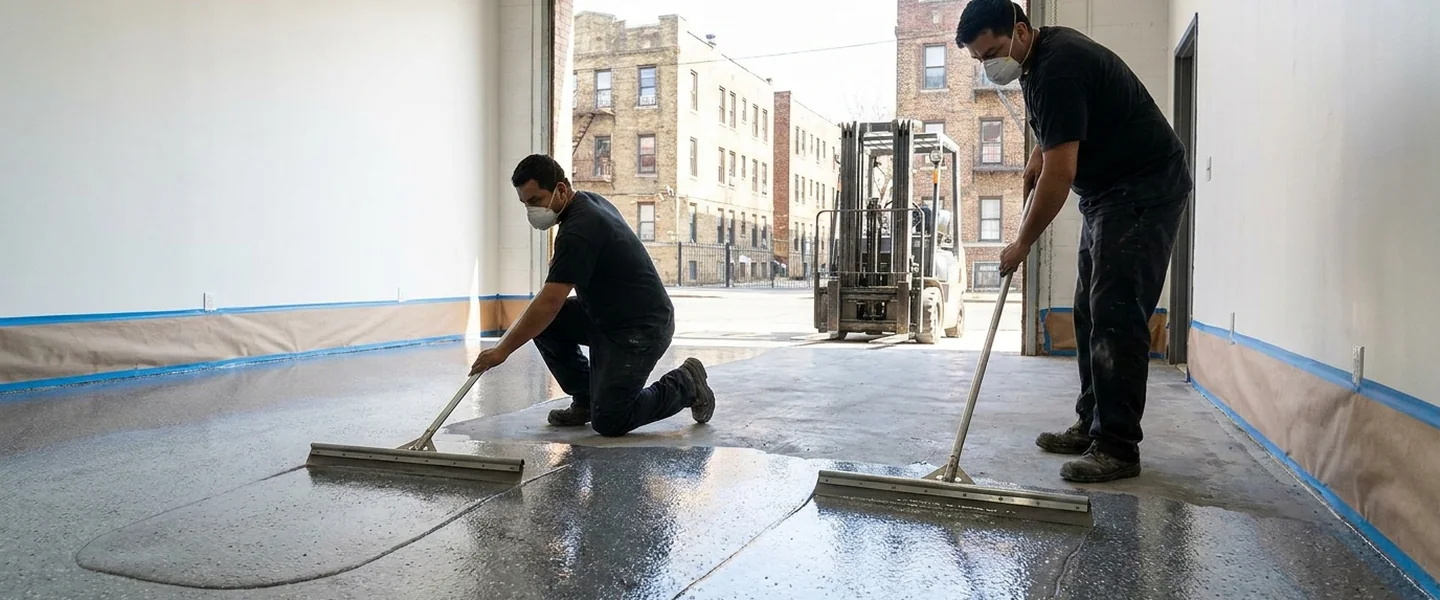
Commercial Epoxy Flooring Boston, MA
High-traffic commercial epoxy systems for warehouses, auto shops, clinics, commercial kitchens, and retail spaces across Greater Boston. Chemical-resistant topcoats. Free written estimate.
Call Now: (857) 340-4574Commercial Epoxy Flooring for Greater Boston Businesses
Commercial epoxy flooring from Boston Epoxy Floor Pros is engineered for the demands that residential systems aren't built to handle: forklift and pallet jack traffic, chemical spill exposure, FDA-compliant surfaces for food prep, OSHA-compliant slip resistance, and continuous foot traffic across thousands of square feet. We spec the system for your load and chemical environment — not a one-size-fits-all residential product applied at commercial scale. Call (857) 340-4574 for a free on-site assessment and written estimate.
What Commercial Epoxy Means in the Greater Boston Market
Greater Boston's commercial real estate market encompasses auto service centers in Quincy and Dedham, food production and biotech facilities in Waltham and Cambridge's Kendall Square corridor, veterinary and medical clinics throughout the metro, and industrial warehouse space in the Route 128 belt. Each environment demands a different epoxy specification: a vehicle service floor needs a chemical-resistant topcoat that handles brake fluid, motor oil, and transmission fluid; a commercial kitchen needs a USDA-compliant, seamless system with integral cove base; a biotech lab needs an ESD-dissipative or ESD-conductive floor tied to a groundable system.
We don't sell a single commercial product to all buyers. The first step in every commercial engagement is a site assessment that documents the traffic type, chemical exposure, load rating, and regulatory requirements specific to your facility.
Project Details
| Detail | Specifics |
|---|---|
| Install Timeline | 1-5 days depending on square footage and system specification |
| Prep Method | Commercial diamond grinding or shot blasting (high-production commercial machines) |
| System Options | Standard broadcast flake, self-leveling, quartz broadcast, mortar system, ESD, urethane cement for hot environments |
| Load Capacity | Up to 10,000 psi compressive strength on mortar-body systems |
| Chemical Resistance | Resistant to oils, fuels, mild acids, alkalis, and solvents; see spec sheet for specific chemical exposure |
| Compliance Options | USDA/FDA-acceptable seamless systems; OSHA slip-resistance compliant; ESD/static control available |
| Warranty | Quoted per project specification — commercial terms differ from residential |
| Pricing | Quoted per job after free on-site assessment — itemized written quote |
Our Commercial Installation Process
Site Assessment and System Specification
We visit your facility, document slab condition and square footage, assess traffic patterns and load requirements, identify chemical exposure, and review any regulatory or compliance requirements. We spec the correct system — not a default product — and provide a written quote within 48 hours.
Commercial Surface Preparation
Commercial floors require industrial-scale prep: high-production diamond grinders and shot blasters for facilities over 2,000 sq ft. We coordinate scheduling to minimize business disruption — section work, night shifts, or weekend installs for occupied facilities.
Substrate Repair
Commercial slabs often have control joint damage, forklift impact cracking, and heavy oil contamination. We address all of this before coating — joint repair, crack routing and fill, oil decontamination treatment, and spall repair as documented in the quote.
System Application
Application method and layering depend on the specified system: broadcast flake for standard commercial, self-leveling for precision flat finishes, quartz broadcast for slip-resistant food service floors, urethane cement for hot environments. Multiple coats with proper inter-coat timing for each system.
Cure and Return-to-Service
We document the cure schedule in writing — when the floor can handle foot traffic, vehicle traffic, and chemical exposure at full service levels. We do not release the floor to service before it's ready.
Documentation and Warranty
Written warranty, product data sheets, and safety data sheets provided at project completion. Commercial clients receive maintenance schedules and approved cleaning product lists for compliance documentation.
Commercial Applications We Serve
Auto Service and Dealerships
Vehicle service floors in Quincy, Dedham, and Waltham requiring oil-resistant, chemical-resistant surfaces that handle floor jacks and tire traffic. Broadcast flake for traction and hide-the-dirt aesthetics common in service bay applications.
Warehouses and Distribution
High-load warehouse floors on Route 128 and I-495 requiring forklift-rated mortar systems or high-build epoxy with diamond-plated joint treatment. Stripe and demarcation line painting included.
Commercial Kitchens and Food Production
USDA-acceptable seamless quartz systems with integral coved base for Boston-area restaurant, catering, and food manufacturing facilities. Non-porous, easily sanitized, slip-resistant when wet.
Medical, Veterinary, and Laboratory
Seamless self-leveling systems for clinical environments requiring chemical resistance and easy sanitation. ESD-dissipative and ESD-conductive systems for laboratory and electronics environments in Cambridge and Waltham biotech corridors.
Frequently Asked Questions
How long does a commercial epoxy install take?
Small commercial spaces (under 2,000 sq ft) can often be completed in 2-3 days. Large facilities require more time — we schedule in sections to minimize disruption and can work nights and weekends for occupied buildings. Timeline is specified in the written quote.
Can you work around an operating business?
Yes, with section planning and off-hours scheduling. We regularly install in operating facilities by working in zones, scheduling cure windows around business hours, and coordinating with facility managers for traffic rerouting. Requirements are documented in the project plan.
What's the difference between commercial and residential epoxy systems?
Commercial systems use higher film thickness, harder topcoat chemistries, and often include aggregate broadcast or urethane topcoats for heavy-traffic durability. Residential systems are engineered for vehicle and foot traffic; commercial systems are engineered for pallet jacks, forklifts, heavy equipment, and continuous chemical exposure. The prep is also scaled — commercial jobs use industrial grinders and shot blasters, not the smaller machines appropriate for residential garages.
Do you provide documentation for regulatory compliance?
Yes. We provide product data sheets, safety data sheets, and written warranty for every commercial project. For food service facilities requiring USDA documentation, we provide the manufacturer's letter of acceptability. For ESD systems, we provide ground resistance test results post-installation.
What's the service area for commercial work?
We serve Greater Boston and surrounding communities including Cambridge, Waltham, Quincy, Dedham, Newton, Medford, and Somerville. Call (857) 340-4574 to discuss your facility location.
Materials We Use for Commercial Applications
| System Type | Product / Spec | Best Application |
|---|---|---|
| Standard broadcast flake | Wolverine Coatings high-build epoxy base, Penntek polyaspartic topcoat | Auto service, retail, light commercial with standard foot and vehicle traffic |
| Self-leveling epoxy | 100% solids self-leveling epoxy, 40-60 mil DFT | Precision flat finish for medical, laboratory, and clean-manufacturing environments |
| Quartz broadcast | Silica quartz aggregate broadcast, urethane topcoat | Commercial kitchens, food production, veterinary — slip-resistant when wet, easily sanitized |
| Urethane cement | Flowcrete urethane cement mortar, 1/4" to 3/8" body | Industrial kitchens, breweries, pharmaceutical — withstands thermal shock and steam cleaning |
| ESD-dissipative | Conductive primer + ESD-dissipative epoxy topcoat, copper grounding grid | Electronics manufacturing, biotech labs, server rooms along Route 128 corridor |
Commercial Floor System Warranty
Commercial warranty terms are specified per project based on the system installed, the traffic and chemical exposure conditions documented at inspection, and the substrate preparation method used. Standard commercial installations carry a 5-year workmanship warranty; heavy-build and mortar-body systems with verified substrate preparation carry up to 10-year coverage. All commercial warranties are in writing, signed at project completion, and include the product data sheets and substrate test documentation that support the warranty claim.
What commercial warranties do not cover: damage from chemicals or thermal exposure outside the specified system rating (documented in the product data sheet provided at closeout), impact damage from dropped loads or vehicle incidents, or modification of the floor coating by a third party without our written authorization. Systems installed to correct non-compliant substrate conditions discovered after installation are warranted based on the corrected specification, not the original scope.
We provide warranty documentation in a format suitable for facility maintenance records, insurance documentation, and future contractor reference. Commercial properties that change hands benefit significantly from complete floor installation records — the next building operator knows exactly what system is installed, what it's rated for, and how to maintain it.
After the Commercial Install — Maintenance and Care
Return-to-service schedule: We provide a written return-to-service schedule for every commercial installation, specifying when the floor can handle foot traffic, equipment loading, vehicle traffic, and chemical exposure at full operational levels. Commercial clients must follow this schedule to maintain warranty coverage — returning heavy forklift traffic to a floor before the cure window is complete is the most common cause of commercial coating failure that we're asked to address post-installation.
Daily and weekly maintenance: Commercial epoxy floors should be swept or dust-mopped daily and wet-mopped with a pH-neutral cleaner weekly. For food service and medical applications, we provide an approved cleaning product list with the installation documentation — some disinfectants and degreasers are chemically aggressive toward specific topcoat chemistries, and using the wrong product can shorten topcoat service life substantially.
Annual inspection: We recommend an annual visual inspection of commercial floors, particularly in high-traffic zones and at control joints where wear concentrates. Early detection of joint failure, topcoat wear-through, or substrate cracking allows targeted repair before damage propagates across the wider floor area. We offer scheduled annual maintenance inspections for commercial clients on a retainer basis — contact us for details.
Greater Boston seasonal notes: Commercial facilities with loading docks, drive-through bays, or exterior-facing vehicle entrances in the Boston metro should include a spring de-chlorination step — power-washing the floor at the start of the season to remove accumulated road salt residue that vehicle traffic tracked in over winter. Salt residue left to sit on commercial epoxy through a warm spring accelerates topcoat degradation at the salt contact points, particularly in lower-traffic areas where it isn't mechanically swept away by foot traffic.
Free Commercial Epoxy Assessment — Greater Boston
On-site visit, system specification, written quote within 48 hours. No pressure. No defaults — we spec what your facility actually needs.
Call (857) 340-4574What You Get in Our Quote vs. the Lowball Bid
We don't compete on the lowest sticker price — we compete on the quote that gets the job actually done. Here is what is included in every quote we write, and the cut-corners that show up in cheaper bids.
Included in our written quote
- Concrete moisture + porosity testing
- Crack and pitting repair before coating
- Full diamond-grind surface prep
- Written quote with flake/coat specs
- Cure-time schedule you can plan around
- 5-year warranty against delamination
Cut corners in the lowball bid
- Coating over uncured or wet slab
- Roller-only prep (no diamond grind)
- Lowball quotes without crack repair
- Subbed-out installation
- No moisture testing before coat
- Warranties full of fine print